

The best age to start learning English: what science says
One of the questions we hear most often at International School Costa Brava‘s information sessions is an almost universal one: when should my child start learning English? Behind that question lies a legitimate concern — parents want to seize the right moment without adding unnecessary pressure.
The answer from neuroscience is clear, and in many cases, surprising: the earlier, the better. But qualifying that ‘earlier’ matters just as much as the advice itself. It’s not about sitting a two-year-old down with flashcards, but about understanding how the developing brain works and what conditions produce the most effective and lasting language acquisition.
The key points at a glance
The critical period for language learning: what neuroscience says
The concept of a ‘critical period’ in language acquisition was popularised in the 1960s by linguist Eric Lenneberg and has been supported and refined by decades of subsequent research. The central idea is that the human brain has a time window during which it absorbs languages naturally, almost involuntarily, without the need for formal instruction.
During this period, the brain processes the foreign language using the same neural circuits it uses for the mother tongue. Once past that threshold — which research places approximately between the ages of seven and twelve, depending on the skill being studied — language learning comes to rely more heavily on areas associated with explicit reasoning, making it slower and less intuitive.
This does not mean that learning English as a teenager or adult is impossible — clearly it is not — but that the nature of the process changes. At ISCB we believe in early exposure precisely because we want English not to be a language our students ‘learn’, but one they ‘live’.
Ages 0 to 3: a brain ready for any language
Babies are born with an extraordinary ability: they can distinguish the sounds of every language in the world. A newborn can differentiate the phonemes of Spanish, Chinese and English equally well. This ability naturally decreases as the brain ‘specialises’ in the sounds of the language or languages in its environment.
This is why exposure to English in the first three years of life — through songs, books, videos or adults who speak with the baby — lays phonological foundations that are very difficult to replicate later on. This is not about formally teaching English, but about keeping active the brain circuits that process those sounds.
In contexts where both parents speak different languages, this stage is where simultaneous bilingualism is built.
In the context of a school like ISCB, what we do is complement that family environment with constant immersion from Early Years.
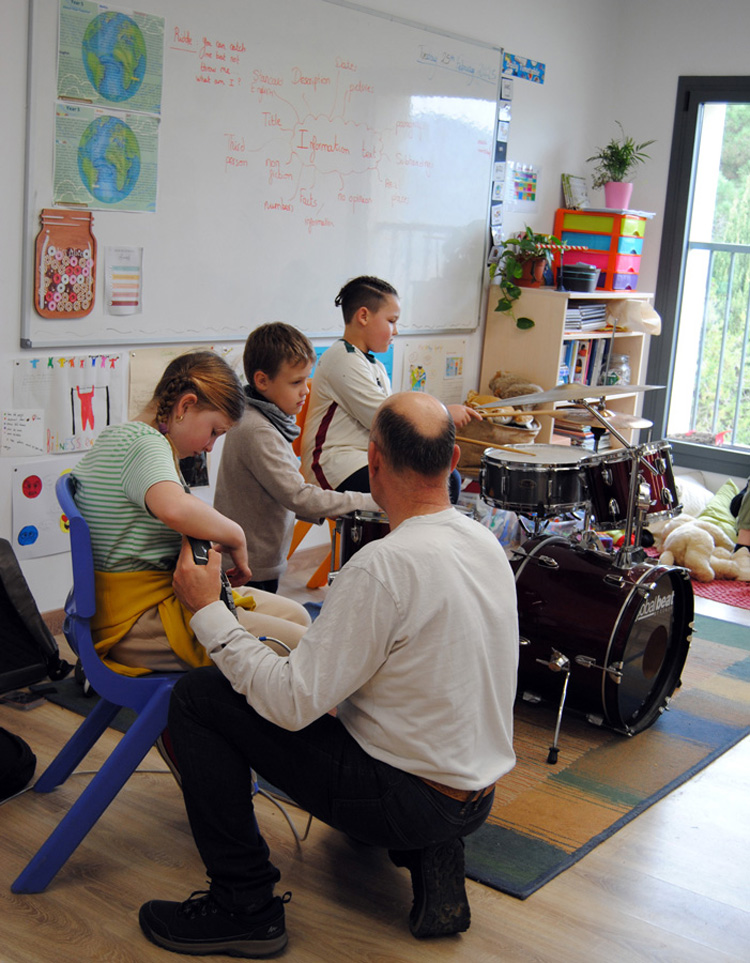
Ages 3 to 6: the golden window for natural learning
If there is an ideal moment to begin schooling in English, research consistently points to the three-to-six age range. At this stage, children learn the language in the same way they learn their own: through exposure, imitation and play. They do not need anyone to explain grammar or conjugations.
A 2018 study published in the journal Cognition analysed data from more than 670,000 participants and concluded that intensive English learning before the age of ten produces a level of grammar comparable to that of native speakers. Those who started between the ages of three and six showed the strongest long-term results.
At ISCB, the Early Years stage is designed precisely to take advantage of this period. Classes are taught entirely in English, but learning is always contextual: children acquire the language while painting, building, singing or exploring the natural environment of the Costa Brava. English is not a subject: it is the medium through which everything else happens.
Ages 7 to 12: still room, but the approach changes
If your child is seven, eight or ten years old and has not yet had intensive exposure to English, the good news is that the period of greatest plasticity has not fully closed. Studies show that children in this range are still capable of reaching very high levels of fluency, especially if the environment is immersive.
What changes is the initial pace: in the first few months, a child of this age may need slightly more explicit support than a four-year-old would. But the adaptability of the young brain is remarkable, and in an environment like that of an international school, progress tends to be rapid.
At ISCB we have students who join us in Primary from other educational systems. Our teaching team applies specific linguistic support strategies for these cases, ensuring that the transition to English as the language of instruction does not become a barrier to content learning.
Adolescence: learning English through a different approach
From around twelve or thirteen, language learning changes in nature. The ability to learn English does not disappear, but the process depends more on conscious strategies, sustained exposure and deliberate practice. Pronunciation is the skill most affected by the critical period: achieving a native accent is statistically less likely when learning begins in adolescence.
However, teenagers have their own advantages: greater analytical capacity, a broader vocabulary in their mother tongue that can serve as a bridge, and more autonomous motivation when the language has a clear purpose (travel, films, music, foreign universities).
In ISCB’s Secondary stage, students work with English as the language of instruction across all subjects and prepare for Cambridge IGCSE and A-Level qualifications, which are recognised by universities worldwide. For a student who reaches this stage with strong English foundations, the academic horizon expands significantly.
How the neuroscience of language shapes our approach at ISCB
At International School Costa Brava we do not teach English as just another subject. We apply a full immersion model designed specifically to harness the brain plasticity of the early years and maintain progress coherently in the stages that follow.
From Early Years, English is the language of the classroom, play, projects and the exploration of the natural environment. Our teachers — all native speakers or holders of a certified C2 level — create an environment where the language is acquired naturally, not memorised artificially.
We believe in holistic development: English is not the goal, it is the tool. The goal is to form global citizens with critical thinking, curiosity and the ability to communicate and collaborate in any cultural context. The Costa Brava, with its natural environment and diverse community, is the perfect setting for that learning to take place in a real and meaningful way.
Science is clear: the earlier you start, the more natural the process will be. But it is also clear about something schools sometimes forget: what determines the outcome is not just when you start, but the quality and intensity of exposure. A child in a genuine immersion environment learns more in one year than another child with two hours of English classes per week over ten years.
Would you like to see first-hand how we approach English at each educational stage? Visit our facilities or request an information session and discover the progress your child can achieve.
Frequently asked questions about the best age to learn English
Research places the period of greatest brain plasticity for linguistic learning between the ages of zero and seven. Children who start before the age of six tend to develop pronunciation and grammatical intuition very close to those of a native speaker. That said, starting between seven and twelve also produces excellent results if the environment is immersive.
It is perfectly possible to join ISCB in Primary with a low or even no initial level of English. Our team applies specific linguistic support strategies for these students, with personalised monitoring. Immersion in the school environment accelerates progress markedly, and most students reach a fluent working level of English within the first year.
No. Research on bilingualism consistently shows that learning two languages from an early age does not 'take away' capacity from either of them. On the contrary, bilingual children develop metalinguistic skills — the ability to reflect on language — that benefit both languages and also facilitate the learning of a third.
